Showing posts with label feminist science fiction. Show all posts

Sunday, February 02, 2020

SLY BANG REVIEWED IN INTO THE VOID


Read Charles Rammelkamp's review of Sly Bang, which appears in the current issue of edgy print journal Into the Void.

Sly Bang by Larissa Shmailo
Reviewed by Charles Rammelkamp

“Sly Bang”
Novel
Spuyten Duyvil, 2019
$18.00, 198 pages
ISBN: 978-1-947980-98-3

Larissa Shmailo’s novel feels like a mash-up of William Burroughs’s paranoid mind-control fantasies and the kaleidoscopic space fantasies of superhero comic books. Indeed, the “sly bang” in the title alludes to the plot to destroy the universe by the – mad scientist? sui generis bad guy? – Prince Eugene (Genya) Ouspensky that the protagonist, Nora (as in Ibsen’s Doll House), aka, Larissa Ekaterina Anastasia Nikolayenvna Romanova, is determined to thwart. But this is not a traditional what-happens-next narrative, though by the end it does “feel” like a resolution has been reached.

But people die and come back to life all over the place, so who can tell, and we are often treated to flashbacks to World War II era concentration camps and Soviet gulags. Ouspensky pursues Nora/Larissa through the whole strange space-time warp of this science-ficitiony world. Ouspensky can read Nora’s mind, trying to control her. But “Larissa artfully dodges sex with Ouspensky by role-playing Anna and Vronsky, Lara and Zhivago, and he enjoys this.” Nora is an FBI agent (not necessarily a good thing, more sinister than salubrious) with telepathic, comic book superhero powers of her own.

Speaking of “sly,” Shmailo often makes these amusing, satirical references to the cornerstones of western civilization, from Heidegger and Nietzsche and Tolstoy to John Lennon and Patti Smith. “Hillary Clinton lay on the table wriggling, bound and gagged.” Johnny Depp provides occasional voiceover.

Shmailo uses a variety of literary forms in the construction of her novel. The book opens up, stage drama-like, with stage direction and setting and off-stage voices, as we encounter Nora masturbating on a leather couch.  As in a play, the dialogue is written:

MICHAEL:  Hey there!

NORA: Hello, Michael, are there walls between us, buildings, I hope?

MICHAEL: Yes, and I’ve triple-locked the door and bound my feet…

The writing then moves to a more conventional style of an omniscient narrator voice moving the story along. But don’t get used to any particular style! Shmailo seems to be having fun subverting readers’ expectations.

For just as easily, Shmailo will burst out into poetry, including sublime lyrics like HOW MY FAMILY SURVIVED THE CAMPS, Nora’s poem.

            Was micht nicht umbringt, macht mich starker:
            What does not kill me makes me stronger.
            Nietzsche said this about other things.
            Not this.

            How did my family survive the camps?
            Were they smarter, stronger than the rest?
            Were they lucky?
            Did luck exist in Dora-Nordhausen,
            Auschwitz and Bergen-Belsen?

This comes from an episode involving Nora’s mother, Leda, in which we read in Nora’s backstory, reminiscent of the “origin story” of so many comic book superheroes. Leda, we learn, conceives Nora in the Brooklyn neighborhood of Williamsburg in 1946 “with the last sex she will ever have.” Of course, Leda’s resentment about this is a factor later on.

But it’s best not to give away the plot, spoiler-like, especially as the plot, like a dream, is subject to the interpretation of every reader, which may be the ultimate point of Shmailo’s satire.  Still, after so much gore and blood and guts and sexual perversity, it’s hard not to smile at the fairy tale ending when the character Bensinck “dropped to one knee and took her hand” like Prince Charming swooning over Cinderella. Dim the lights. Shine a soft spot on the dude. With what seems the sincerity only an earnest fairy tale prince can display, he says to her, “No more undercover, no more faking it. Just us, and a quarter of the world’s land mass.” Hah!

And Nora, God bless her, having just a moment before read through a story she’s written about killing Ouspensky after he has an orgasm inside her (“ He starts fucking her with his tiny dick and Nora starts fantasizing about killing him and it turns her on.”), smiles sweetly and responds: “And create a world safe for our children, Albert? Or am I going too fast for you?”   

But wait, that’s not all! The story is followed by APPENDIX; NORA’S SLAA SEXUAL HARMS INVENTORY (FRAGMENT). Her sexual ideal? “I have sex with a man  whom I love and respect and trust and am attracted to and who loves and respects and trusts me and is attracted to me as part of a committed relationship and as a byproduct of sharing and partnership. Our sex is creative, playful, imaginative and hot. [following pages illegible]”  There follows a series of fragments about various men and her “reasons for getting involved.”

Do you get the uncomfortable feeling that Shmailo is playing the reader, having us on? It’s this discomfort that’s finally at the heart of the writing, masterful satire whose object is constantly shifting and, yes, may be you. You just have to read Sly Bang yourself and come to your own conclusions.  You won’t regret it.


Charles Rammelkamp

Monday, October 14, 2019

GREAT REVIEW OF SLY BANG IN BOOKS FOR READERS

Read Meredith Sue Willis's great review of SLY BANG in Books for Readers #204!
And now for something completely different-- a new novel by Larissa Shmailo, continuing her themes that include feminism, female sexuality, power struggles, and a family that may have collaborated with the Nazis, but also suffered hugely themselves. She writes again about a powerful, debilitating combination of sex addiction and sexual abuse. This time she does it with a rollicking, often comic (and comic book style) fantasy/science fiction story.
Her main character is Nora, a psychologically damaged but uber-resilient hero who spends a lot of time in a coma, drugged, or otherwise disabled-- because the bad guys and the good guys are all and constantly aware of her power and trying to channel it, or kill it, for their own purposes..
The neat psycho-spiritual trip here is that Nora remains through all the abuse and danger and rising one more time to rejoin the battle--a deeply Christian character--that is, not that she particularly practices Christianity or even believes in God, but she is committed to forgiving and loving. Her special bailiwick is vicious serial killers like her sometimes charming. occasional savior Michael, whose idea of a special treat is sex with dead, young vaginas. But he is NOT, he insists, a pedophile. Michael is, like Nora, a multiple personality.
This novel, not surprisingly, has some of the quality of a fever dream, and one could imagine at any moment being awakened and told it was, indeed, all a nightmare, but that is never the point. The point is the ride, the changes, the themes played and dropped and played again. It picks up momentum throughout, and the final section moves into even faster changes, ending with short dispatches from an action packed summary, with more flips and twists. Nora triumphs in the end, offering us a poem in which she entertains Satan himself.
AMAZON.COM
Larissa Shmailo’s Sly Bang is a futuristic hallucinogen of a novel that pervades your consciousness. Our heroine Nora could be the love child of Barbarella and Hunter S. Thompson if she grew up to be a telepathic FBI agent. Her story will make you wonder if all wars are truly fought on the battle....

Tuesday, August 20, 2019

RAIN TAXI REVIEW OF SLY BANG


SLY BANG


Larissa Shmailo
Spuyten Duyvil ($18)
by Jefferson Hansen
Larissa Shmailo’s Sly Bang is written with tremendous energy and moves at an exhilarating pace, yet it dwells on depraved characters and actions. Almost nobody is nice in this novel about serial killers, mad scientists, FBI agents and evildoers.
The plot centers around Nora, an FBI agent with telepathic and scientifically grounded superpowers, who is hunted by Ouspensky, a scientist, satanist, and Nazi who wants to destroy the world using nuclear colliders. Among Nora’s defenders are Michael, a serial killer, and Andrew and Aubrey, fellow FBI agents who seem to be the only characters without obsessions, perversities, and obscene desires.
Indeed, the book reads like a psychotic episode. People die and come back to life. The line between dream and reality is not entirely clear. Mind-reading is possible. Strange, advanced technologies propel the action at times. Some characters have superhuman abilities: Most of the men have extraordinary strength and beat up a slew of other people to prove it. They can even break their way out of manacles.
And that is where the satire lies. The book, while it portrays horrific actions, makes fun of superhuman male figures and the traditional ideal man. Their activities are so outlandish that readers may find themselves laughing out loud and cheering as Nora outlasts most of them through her grit, pluck, and resilience. As she contemplates being saved by a man, she writes “hey, this damsel in distress thing really turns them on . . . subconscious hostility that they want me to be harmed?” The book takes direct aim at the fantasies of some males, making them so extreme that their absurdity becomes crystal clear.
Sly Bang’s satire on the whole is extreme—it begins with a scene of Nora masturbating under command while being remotely surveilled. She is alone, sleep deprived, and very scared. Serial killers lurk blocks away, pretending to be friends, and attempt to confuse her through remote communications. She needs to fight the depravities of the males, who are lampooned in their aggressiveness and inability to treat Nora straight. And Nora has her own issues. She treats men badly by manipulating their feelings, loving them and leaving them, cheating on them, and so forth. It may be a kind of visceral revenge.
To top it all off, Nora and her “friends”—neither she nor we are entirely sure who is or isn’t on her side—need to save the world from Ouspensky’s attempt to destroy it just for kicks. The comic book element makes war itself seem cartoonishly absurd, driven not by a desire for territory or money or power, but to dominate women in a psycho-sexual manner.
This is a hilarious and horrifying novel. It depicts the worst humanity is capable of, but what keeps Sly Bang from becoming overwhelmed by the depravity it describes is the writerly energy of Shmailo. Wise cracks and madcap scenes burst one after another in a buoyant fashion—so it goes down easy in spite of the horrors it describes.

Click here to purchase this book
at your local independent bookstore
indiebound

Wednesday, February 06, 2019

SLY BANG PRESS RELEASE

For immediate release
Contact: Sliding Scale
646-326-9816

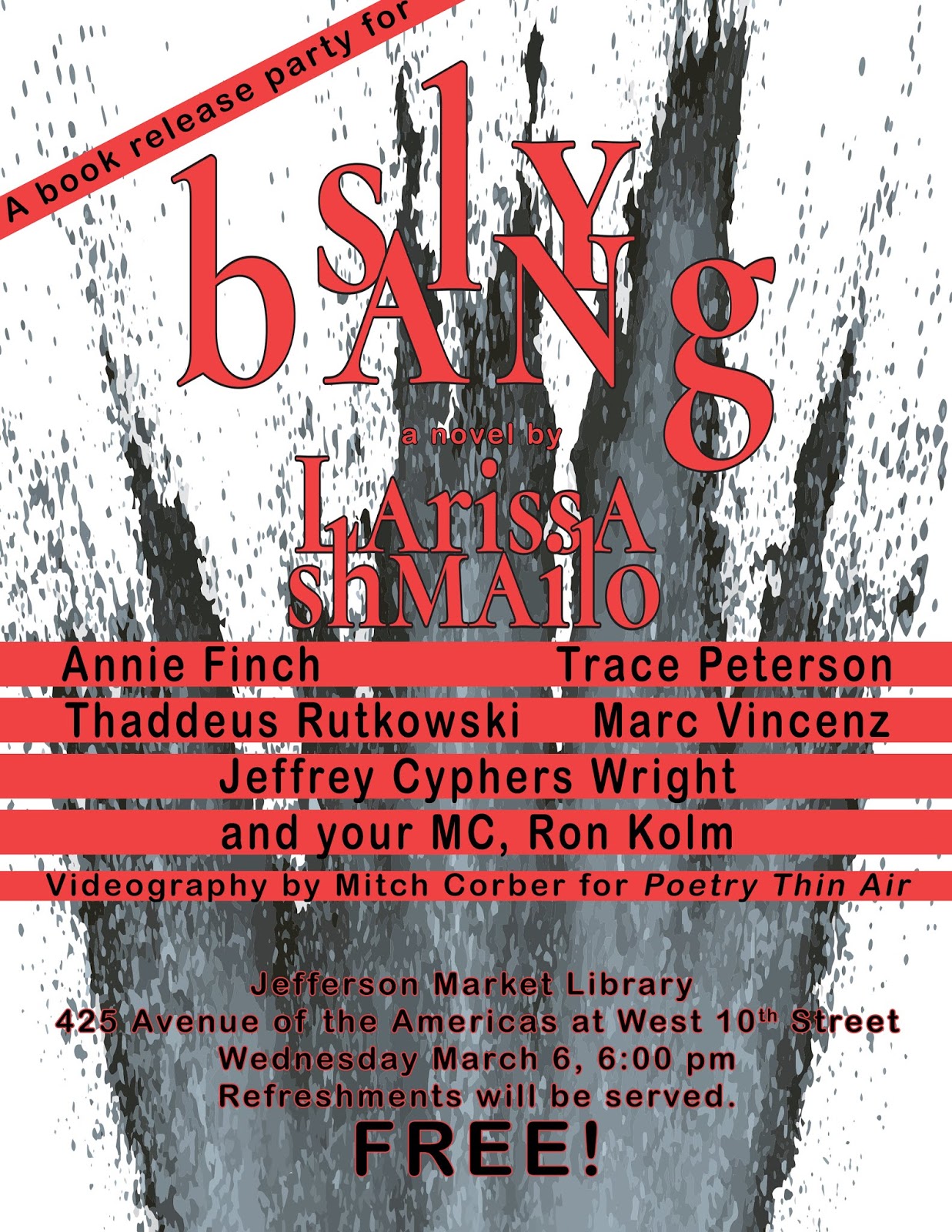
SLY BANG BOOK RELEASE PARTY
Jefferson Market Library
425 Avenue of the Americas at West 10th Street
March 6 at 6:00 P.M.
FREE!

New York City. On March 6, an elite group of poets and writers will convene to celebrate Larissa Shmailo’s new novel, Sly Bang. Called “astounding,” “genre-bending,” and “like nothing else,” Shmailo’s second novel has been recommended to readers who like Gogol, Kafka, Burroughs (“if you reverse the genders”), and a wild literary ride.

The notables assembling for the evening at the historic Jefferson Market Library will read from Sly Bang and respond with readings of their own work. Appearing will be Annie Finch (Spells: New and Selected Poems), Trace Peterson (EOAGH),Thaddeus Rutkowski (Haywire), Marc Vincenz(MadHat), and Jeff Wright (Kathy Acker Award). Emceeing the night will be Ron Kolm of the Unbearables and the Fales Collection of the New York University Library. Bios of the readers and event flyer follow.

Sly Bang is available from Amazon, where it has garnered excellent reader reviews, and from the publisher Spuyten Duyvil. Copies of Sly Bangwill also be available at the book party March 6.

Author Larissa Shmailo is a poet, novelist, translator, editor, and critic. Her new novel is Sly Bang; her first novel is Patient Women. Her poetry collections are Medusa’s Country,#specialcharacters, In Paran, A Cure for Suicide, and Fib Sequence . Her poetry albums areThe No-Net World and Exorcism, for which she won the New Century Best Spoken Word Album award. Shmailo is the original English-language translator of the first Futurist opera Victory over the Sun by Alexei Kruchenych, performed at the Los Angeles County Museum of Art, the Brooklyn Academy of Music, and theaters and universities worldwide. Shmailo also edited the online anthology Twenty-first Century Russian Poetry. 

Annie Finch’s most recent books are Spells: New and Selected Poems (Wesleyan) and Measure for Measure (Random House/Everymans). Her poetry has been performed at Carnegie Hall and the Metropolitan Museum of Art, installed in the Cathedral of St. John the Divine, and published in Poetry, Paris Review, The New York Times, and The Penguin Book of Twentieth-Century American Poetry. A graduate of Yale with a Ph.D. from Stanford, she teaches Five Directions Workshops and performs Poetry Witch Ritual Theater. Forthcoming in 2019 are The Poetry Witch Book of Spells (Wesleyan) and the anthology Choice Words: Writers on Abortion (Haymarket).

Ron Kolm (emcee) is an editor of the 6th Unbearables anthology, From Somewhere to Nowhere: The End of the American Dream. He is a contributing editor of Sensitive Skin magazine. Ron is the author of Divine Comedy, Suburban Ambush, Night Shift and A Change in the Weather. He's had work in Flapperhouse, Great Weather for Media, the Resist Much / Obey Little: Inaugural Poems to the Resistance anthology, Maintenant, Live Mag!, Local Knowledge, The Opiate and the Outlaw Bible of American Poetry. Ron’s papers were purchased by the New York University library, where they’ve been catalogued in the Fales Collection.

Trace Peterson is a trans woman poet critic. Author of Since I Moved In (Chax Press, 2007), she is also founding editor and publisher of EOAGH, which has won two Lambda Literary Awards, including the first given in transgender poetry. She is coeditor of the anthology Troubling the Line: Trans and Genderqueer Poetry and Poetics (Nightboat Books, 2013) and coeditor of Arrive on Wave: Collected Poems of Gil Ott (Chax Press, 2016). Her second full-length book of poems is forthcoming from Ahsahta Press in 2020.

Thaddeus Rutkowski is the author of six books, most recently Border Crossings, a poetry collection. His novel Haywire won the Asian American Writers Workshop’s members’ choice award, and his memoir Guess and Check won the Electronic Literature bronze award for multicultural fiction. He teaches at Medgar Evers College, Sarah Lawrence College, and the West Side YMCA, and is a staff copy editor for Artforum magazine. He received a fiction writing fellowship from the New York Foundation for the Arts.

Marc Vincenz’s tenth collection of poetry is Leaning into the Infinite. He has translated many Romanian-, French- and German-language poets, including Herman Hesse Prize winner, Klaus Merz. He is Executive Editor of MadHat Press and serves on the editorial boards of Plume and Fulcrum.

Jeffrey Cyphers Wright is a publisher, critic, eco-activist, artist, impresario, and poet. He is the author of 16 books of verse, including Blue Lyre from Dos Madres Press, and Fake Liesfrom Fell Swoop. He received an MFA in Poetry from Brooklyn College after studying with Allen Ginsberg. Currently, Wright stages events at KGB Lit Bar, Howl! Happening, and La MaMa ETC in NYC, in conjunction with his art and poetry journal, Live Mag! He is a regular contributor to American Book Review and ArtNexus. He is a Kathy Acker Award recipient and Pushcart Prize nominee for 2018. 

Videography will be by Mitch Corber for the television show Poetry Thin Air.

Spuyten Duyvil would like to thank the Jefferson Market Library and New York Public Library Programs for their generous support hosting the Sly Bang Book Release Party.
https://www.nypl.org/events/programs/2019/03/06/book-release-party-sly-bang-larissa-shmailo

Wednesday, January 23, 2019

TOWARD A NEW NARRATIVE - SLY BANG

"TOWARD A NEW NARRATIVE: SLY BANG REWRITES, rethinks, and reimagines how we conceive of narrative. This slippery novel is a major step forward towards a radiant and explosive language. - Dean Kostos, Pierced by Night-colored Threads

Monday, January 21, 2019

MICHAEL McHUGH''S (McQ) REVIEW OF SLY BANG


Larissa Shmailo's sci fi thriller Sly Bang is a twisted and compelling thrill ride of a novel that not only transcends the form of that literary genre - it blows it up. It's a novel about an attempt to destroy the universe by reverse engineering the Big Bang. It deals with taboo subjects and is raunchy, funny and brutally intense. It's available on Amazon. Book release party at The Jefferson Library in NYC. I also like that's there's a character named Brave McQ. - Michael W McHugh aka McQ.

Saturday, January 19, 2019

Exciting Review of SLY BANG by K.R.Copeland

Thrilled at this brilliant review of SLY BANG by critic Kimberly Rae Lorenz-Copeland:

What do you do when there is a, “Army of serial killers, mad scientists, and ultra rich sociopaths” after you?
Why, you summon your alter, “Larissa Ekaterina Anastasia Nikolayevna Romanova, tsaritsa of all the Russias,” and embark upon Larissa Shmailo’s cornucopiac literary odyssey, Sly Bang, of course.
From Nietzsche’s “what doesn’t kill me makes me stronger”, and Lady Gaga’s meat dress, to sadistic cult leaders and space Nazis, this sci-fi, fantasy, thriller, is chock-full of surprises at every turn. I mean, the lead character, Upper West Side, Manhattanite Nora, is a multiple personality FBI agent/possible alien, with an affinity for serial killers, who telepathically communicates with giant prehistoric birds, AND as luck would have it, writes uncannily brilliant poetry (journal entries).
Yes.
There is a LOT going on in this book.
In my opinion, the (quintessentially Shmailo) Interlude is where Sly Bang lives and breathes - It is the much anticipated doorway through which the reader officially exits suspended disbelief, and enters Nora’s world - her *real* world - introduces, through beautifully crafted poems, the backstory of Nora; a tragic tale of horrific abuse, betrayal, and ultimately, survival.
This stretch of writing - which jets the reader back to World War II, Nora’s camp family history, is nothing short of masterful, and reminiscent of Shmailo’s previous offering, Patient Women. The poem, Warsaw Ghetto, itself, is well worth the price of admission.
Generously infused throughout with humor, ebullient psychosexualism, and quasi-hypothetical political scenarios, this manic mind-trip, where alternate realities collide, full-force, culminating in orgasmic fits and fantastical flurries, Sly Bang, is a bit like eating chocolate cake on a roller coaster. Crazy. Delicious. Chaos.
K.R. Copeland - author of Love and Other Lethal Things

Thursday, December 20, 2018

READ AN EXCERPT FROM SLY BANG!

Thanks to Jonathan Penton of Unlikely Stories for publishing this excerpt from my novel, SLY BANG! You can purchase a copy from Amazon or from my publisher, Spuyten Duyvil, HERE 

READ SLY BANG HERE!!!


Monday, December 17, 2018

GREAT REVIEW OF SLY BANG BY DARRYL WAWA

Read Darryl Wawa's review

On reading Larissa Shmailo's "Sly Bang"

If you are looking for something to get out of your ordinary line of  thinking, Larissa Shmaillo’s Sly Bang ought to do the trick. The book is a psychological sci-fi filled with non-sensical gadgets, absurd dialogue, and all out madness, a batlle royale of good against evil, of womanhood against male perversion that follows William Burroughs's Naked Lunch in reverse, if we consider the gender roles of the protagonists. Lovers of Nikolai Gogol’s Madman’s Diary, and Samuel Beckett’s Waiting for Godotand Frantz Kafka’s stories will also enjoy this book, as opposed to religious and concrete minds, who, by all means, should  stay away from a book like this. Things pop out of nowhere. Characters have multiple personalities that change right before your eyes in ways that make complete sense in the universe created by Shmaillo,but would otherwise make absolutely no sense. And the language, disguised in a veil of blatant grotesquerie, will need a subtle reader to decipher its gems and eloquence. The novel is hilarious, gruesome, repulsive, pervasively perverse, sadistic and moral like a Rick and Morty episode and the story takes place in a building of 300 floors going down, reminiscent of a concentration camp. Nora the protagonist is trying to save the world from an army of sadistic Nazi perverts with whom she is also in love. Other notable characters of the cast are: Michael, her lover, helper and serial killer, Ouspensky, the leading antagonist, sociopath, indiscriminate rapist and also her lover and Larissa, Nora’s interchanging alter ego, and also the supreme ruler of all of Russia. The only thing that seems linear in the novel is the progression of time.
Here are a few hidden gems from the novel, quotes that confess our human tragedy, spread throughout the madness of the book:

“Interesting idea here about false identity, on a spectrum, in all of us, the ego as opposed to the true self. Survival identities shed in recovery to reveal true being and oneness with God. We are all false; who am I to judge?
“Is it evil to destroy evil?” (p65)

 “AS I SEARCH MY HEART I SEEK FOR SOME EMBER OF WHAT I ONCE FELT AND I FIND ONLY SORROW GRIEF DISGUST AND SHAME… I AM SEEKING HELP FOR MY ADDICTION TO YOU SO THAT I DO NOT LAPSE INTO FANTASY AND A STUPOR OF NOSTALGIAC RECALL.” (p66).

“Michael burst into Hawk’s office and shoved the plate of macaroons into her face. He grabbed Nora and began the ascent up 300 flights. It took him 50 flights to realize that Nora, his Nora, was in his arms.
This is holding a real live girl, he mused. This is much better than oatmeal. Even better than hot, if that were possible.
Michael’s energy surged and he flew up the stairs. But by -201, Michael felt his energy drain.
I can’t carry her another two hundred flights, he realized.”  (p69)

““the mind cannot bear a hurt too great to the heart” (p124)

The effect on the reader, is one of  surprise and shock. The author cleverly interweaves poems in the novel as passages from the main character’s journal. The interlude, a historical anecdote about Nora’s parent’s during WWII and her ensuing upbringing, comes in the middle of the story to ground the reader. We are told of accounts of concentration camps and of an unlikely story of survival not as predictably drenched in heroism as it is in betrayal. This second part of the novel surprises as it is told in screenplay format at first, before reverting  back to an ordinary past tense narrative with a ‘normal’ progression. The anecdote traces back Nora’s origins. Along this second part, the sprinkled poems and passages confess  personal feelings, musings, and history of the main character, revealing her troubled upbringing and unsuccessful first marriage. But afterwards, the book goes back to its madness. The chaos continues, and our protagonist is once again trying to save the world. In its exploratively chaotic style, the story comes across as a description and metaphorical answer to quotidian psychopathology. It is a novel in which you can enjoy your own madness, if you are in that mood, but it does so in criticizing outdated masculine behaviors and championing female flexibility. It is a highly entertaining book and worth the read.

“We women will never forget. Those who do not remember history, as those of us who have been drugged and tormented and raped and pissed on and STILL REMEMBER ... I don’t even have words for the contempt I have for you predators.” (p178).


Darryl Wawa is a Port-au-Prince born Haitian-American who studied Photography and Creative writing. He enjoys chocolate and good books. That said, maybe a movie is a good book. He loves to work with images and words and their pairing.

Wednesday, November 07, 2018

SLY BANG NOW AVAILABLE ON AMAZON

My new experimental novel, Sly Bang, is now available from Amazon SLY BANG ON AMAZON

Larissa Shmailo’s SLY BANG is a futuristic hallucinogen of a novel that pervades your consciousness. Our heroine Nora could be the love child of Barbarella and Hunter S. Thompson if she grew up to be a telepathic FBI agent. Her story will make you wonder if all wars are truly fought on the battlefield of the psychosexual female libido.
Cecilia Tan, author of Slow Surrender'

SLY BANG IS ASTOUNDING! The "typhoid Mary of rape and murder," having been determined by alien pterodactyls to be "the only non-Nazi in the universe," teams up with a skinner-alive of pubescent virgins and ardent collector of Rothko daubs. Together they wage war against an ialdabaoth who intends, just for kicks, to atomize the universe by means of particle accelerators. Hyperspatial scene-shifts are conveyed by telepathy or supercomputer-assisted dialogue that bristles with snappy one-liners paced faster than a meth rant. Somehow, across these solar system-spanning pages, supercharged as they are with psycho-, neurobio- and quantum-physical erudition, the plot comes across vivid as anything Tolstoy ever evoked with his most considered panoramic prose. Larissa Shmailo's SLY BANG is like nothing that has ever been seen, or heard, anywhere.
Tom Bradley, author of Useful Despair

In this breakneck, futuristic, socio-sexual-psychological thriller, Larissa Shmailo tells the story of Nora Volkhonsky, a smart FBI agent targeted by multiple evildoers. As bad guys and worse guys close in on her, Nora’s main goal is to survive. She is helped somewhat by her “telepathic” powers, but her experience is often more dream than reality. “Who was sending these clangs and hoodoo messages? Who was receiving hers? Who wanted her insane or dead?” Fasten your seatbelt as you ride along a wicked highway with SLY BANG’s tough, spirited heroine.
—Thaddeus Rutkowski, author of Border Crossings


Blog Archive