Showing posts with label book reviews. Show all posts

Tuesday, August 20, 2019

RAIN TAXI REVIEW OF SLY BANG


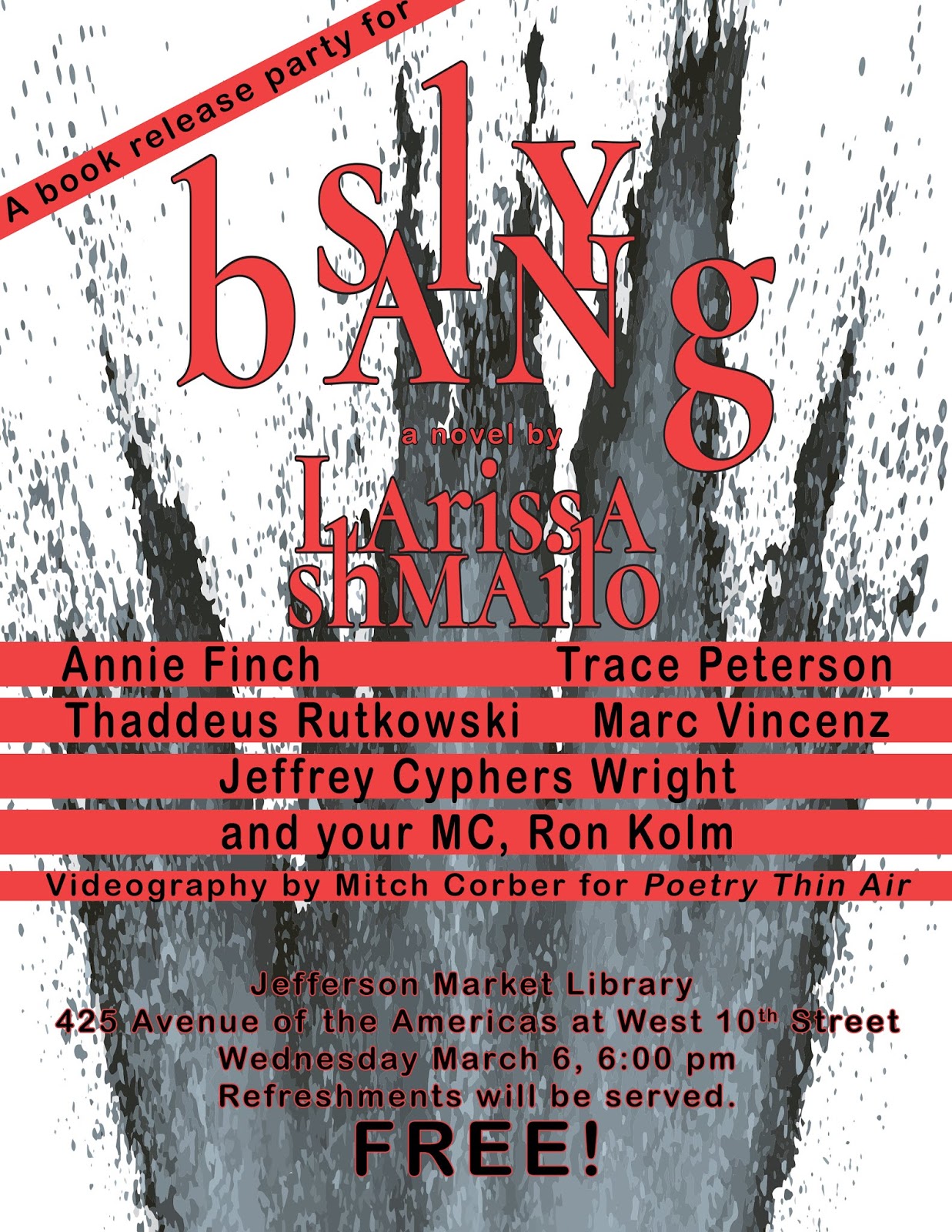
SLY BANG


Larissa Shmailo
Spuyten Duyvil ($18)
by Jefferson Hansen
Larissa Shmailo’s Sly Bang is written with tremendous energy and moves at an exhilarating pace, yet it dwells on depraved characters and actions. Almost nobody is nice in this novel about serial killers, mad scientists, FBI agents and evildoers.
The plot centers around Nora, an FBI agent with telepathic and scientifically grounded superpowers, who is hunted by Ouspensky, a scientist, satanist, and Nazi who wants to destroy the world using nuclear colliders. Among Nora’s defenders are Michael, a serial killer, and Andrew and Aubrey, fellow FBI agents who seem to be the only characters without obsessions, perversities, and obscene desires.
Indeed, the book reads like a psychotic episode. People die and come back to life. The line between dream and reality is not entirely clear. Mind-reading is possible. Strange, advanced technologies propel the action at times. Some characters have superhuman abilities: Most of the men have extraordinary strength and beat up a slew of other people to prove it. They can even break their way out of manacles.
And that is where the satire lies. The book, while it portrays horrific actions, makes fun of superhuman male figures and the traditional ideal man. Their activities are so outlandish that readers may find themselves laughing out loud and cheering as Nora outlasts most of them through her grit, pluck, and resilience. As she contemplates being saved by a man, she writes “hey, this damsel in distress thing really turns them on . . . subconscious hostility that they want me to be harmed?” The book takes direct aim at the fantasies of some males, making them so extreme that their absurdity becomes crystal clear.
Sly Bang’s satire on the whole is extreme—it begins with a scene of Nora masturbating under command while being remotely surveilled. She is alone, sleep deprived, and very scared. Serial killers lurk blocks away, pretending to be friends, and attempt to confuse her through remote communications. She needs to fight the depravities of the males, who are lampooned in their aggressiveness and inability to treat Nora straight. And Nora has her own issues. She treats men badly by manipulating their feelings, loving them and leaving them, cheating on them, and so forth. It may be a kind of visceral revenge.
To top it all off, Nora and her “friends”—neither she nor we are entirely sure who is or isn’t on her side—need to save the world from Ouspensky’s attempt to destroy it just for kicks. The comic book element makes war itself seem cartoonishly absurd, driven not by a desire for territory or money or power, but to dominate women in a psycho-sexual manner.
This is a hilarious and horrifying novel. It depicts the worst humanity is capable of, but what keeps Sly Bang from becoming overwhelmed by the depravity it describes is the writerly energy of Shmailo. Wise cracks and madcap scenes burst one after another in a buoyant fashion—so it goes down easy in spite of the horrors it describes.

Click here to purchase this book
at your local independent bookstore
indiebound

Friday, March 01, 2019

My review of BLUE LYRE BY JEFFREY CYPHERS WRIGHT

 blue-lyre-cover-750x1125

The Romantic Surrealist’s Ear —A Review of Blue Lyre by Jeffrey Cyphers Wright
by Larissa Shmailo.
The second-best thing I like about Blue Lyre, Jeff Wright’s Kathy Acker Award-winning book, is that I can’t pigeonhole the voice, although a surrealist Frank O’Hara with a richer metaphoric lexicon comes to mind. Kinda. For O’Hara, the part where the everyday meets the unexpected trope. For surrealism, Wright’s way with original images and their juxtapositions. For example, these lines from Wright’s invocation of his muse:
.
I pick up some words
and toss them in the air
to see if you pay any mind.
Just to see
if your breath catches fire.
                        —“Begging for It”
.
Wright is a self-proclaimed New Romantic, and perhaps that’s what has been missing from surrealism to date: there is a yearning in these poems with their diamond glitter on the beach that complements the surrealist’s art as it jumpstarts romanticism. Unusual language meets love, and poetic devices are freed from their leashes:
.
Take me to your navel.
“Aye aye, Capitan.”
. . .
Ready for the Canon
to come on.
And by the way, your clown
costume becomes you.
“Aye aye capstan.” Let me
hoist you from the depths.
A winch I’ll be for my wench.”
—“Titania’s Tool”
.
What I like best about Wright’s work is reading it aloud. Live Mag! editor Wright is a known New York impresario of spoken word and the oral tradition, and Blue Lyre’s jazzy rhythms attest to his ear. No mushiness here: The line breaks are crisp as ice and right:
.
            Black plums from Madame X
            conspire on the sill.
. . .
            Following the choir.
            Listening to the “new” air sound.
            Looking for a “new” word order.
                                    —“Thimblerig”
 .
Like a wise Zen teacher, Wright offers his share of koans in Blue Lyre: “Now only ashes remember / how many ways we burned”; and “Always the sky / has the last say” and the brilliantly titled “(B)utterfly)”:
.
            Yeah, well,
            My heart’s a reed
this poem
blows through.
—    “(B)utterfly”
.
With its expansive minimalism, surrealistic romanticism, and page-meets-stage poetry, Blue Lyre would clearly win the approval of Jeff Wright’s muse and, most likely, yours as well.
.Larissa Shmailo is a poet, novelist, translator, editor, and critic. Her latest novel is Sly Bang.

Monday, January 21, 2019

MICHAEL McHUGH''S (McQ) REVIEW OF SLY BANG


Larissa Shmailo's sci fi thriller Sly Bang is a twisted and compelling thrill ride of a novel that not only transcends the form of that literary genre - it blows it up. It's a novel about an attempt to destroy the universe by reverse engineering the Big Bang. It deals with taboo subjects and is raunchy, funny and brutally intense. It's available on Amazon. Book release party at The Jefferson Library in NYC. I also like that's there's a character named Brave McQ. - Michael W McHugh aka McQ.

Saturday, January 19, 2019

Exciting Review of SLY BANG by K.R.Copeland

Thrilled at this brilliant review of SLY BANG by critic Kimberly Rae Lorenz-Copeland:

What do you do when there is a, “Army of serial killers, mad scientists, and ultra rich sociopaths” after you?
Why, you summon your alter, “Larissa Ekaterina Anastasia Nikolayevna Romanova, tsaritsa of all the Russias,” and embark upon Larissa Shmailo’s cornucopiac literary odyssey, Sly Bang, of course.
From Nietzsche’s “what doesn’t kill me makes me stronger”, and Lady Gaga’s meat dress, to sadistic cult leaders and space Nazis, this sci-fi, fantasy, thriller, is chock-full of surprises at every turn. I mean, the lead character, Upper West Side, Manhattanite Nora, is a multiple personality FBI agent/possible alien, with an affinity for serial killers, who telepathically communicates with giant prehistoric birds, AND as luck would have it, writes uncannily brilliant poetry (journal entries).
Yes.
There is a LOT going on in this book.
In my opinion, the (quintessentially Shmailo) Interlude is where Sly Bang lives and breathes - It is the much anticipated doorway through which the reader officially exits suspended disbelief, and enters Nora’s world - her *real* world - introduces, through beautifully crafted poems, the backstory of Nora; a tragic tale of horrific abuse, betrayal, and ultimately, survival.
This stretch of writing - which jets the reader back to World War II, Nora’s camp family history, is nothing short of masterful, and reminiscent of Shmailo’s previous offering, Patient Women. The poem, Warsaw Ghetto, itself, is well worth the price of admission.
Generously infused throughout with humor, ebullient psychosexualism, and quasi-hypothetical political scenarios, this manic mind-trip, where alternate realities collide, full-force, culminating in orgasmic fits and fantastical flurries, Sly Bang, is a bit like eating chocolate cake on a roller coaster. Crazy. Delicious. Chaos.
K.R. Copeland - author of Love and Other Lethal Things

Thursday, January 03, 2019

My Review of EDJU by RW Spryszak

edju

The Surrealism of War, Politics, Religion and Everything Else
By Larissa Shmailo
RW Spryszak;s Edju is a compelling, thought-provoking read, possibly one of the best antiwar novels since Dalton Trumbo’s Johnny Got His Gun. Its eponymous unreliable narrator is certainly as odd as Trumbo’s and every bit as opinionated. Edju’s point of view is skewed, we suspect, but the surreal world he encounters is undeniably more so. Populated by fantastic saints, monstrous war machines, and fatalistic animate metaphors of death, the world of Edju threatens us with the core horror of humans systematically killing one another for questionable ideas.
Reading Edju, I saw elements of the original picaresque novel in the adventures of its Quixotic, but always truthful, protagonist. But his story—a hagiography, perhaps, if Edju’s time-warping memory serves— is a continuing exercise in excess, an attempt to trump absurdist and surrealist writing of past several centuries. There are loud shout outs to Gogol’s nose and Kharm’s corpses, and more than a few scenes that are reminiscent of Kafka and even an absurdist Robinson Crusoe.
All of this is done in a slow reveal—we learn the name of the narrator, an old man mocked by children only in the eighth chapter. We assume Edju is mad, hopelessly odd, a compulsive-obsessive religious fanatic, a kook who thinks his dead lover is strangely and selectively alive in a sack. As his Nordic world unfolds in subsequent chapters, we come to believe this limited being is the only sane man on his dystopic nation.
The central conceits of the novel, Edju’s windmills, are surreal metaphors for war and competition in reduction ad absurdem: war machines fueled by human bodies, a Mountain of Flesh all are eager to climb, factions absurdly fighting over table cloths which have become their last banners, a Maze of defense. The path to war is depicted accurately, starting with pamphlets and the rise of fascism and inevitably followed by
Leftist Agrarian Front. Rightist National Unity. Holy Orders of the Fist of God. The Liberal Party. The Conservative Party. Liberal Conservatives and Conservative Liberals. The Armed Hand of the Nation. Nuns. All armed. All vying for power
And:
Évitez les faux, they shouted. Libérez nos bébés, they called. N’accepte pas les substituts. It seemed like a full-scale rebellion was at hand. I had no idea if those phrases were in any way grammatical and correct. But in times of revolution even the commas get misplaced.
Religion fares no better than politics. In nomenclature reminiscent of David Foster Wallace’s Year of the Depends Undergarment, faith in Edju’s universe is represented by Bibliana, saint of headaches and hangovers, Our Lady That Didn’t Tumble, Saint Fomildehyde, and extremely peculiar paths to canonization.
The writing of Edju is synaesthetic and witty, replete with eyepopping detail, zinger similes, and wise one liners:
Death makes everyone an outcast.
.
There was a tan gray moon, a pure slice of venom in the blood, floating overhead.
Climbing up the em­bankment was a struggle, but her perfume reached out like a muscular ghost that held me close to its face of vapors. As wrong as elephants.
Left to the devices of nature all things decay. Why is this not the basis of the theory of everything they search for?
The rain fell so hard it opened graves.
.
If you are not them, you are the other. It’s in the Constitu­tion now.
Firing a gun is like fucking a ghost.
.
RW Spryszak’s unusual hero’s journey belongs on your reading list. Like many fine works that eptly mine and mime our culture, it is novel, in the first meaning of the word.
You can find the book here:

Blog Archive