Showing posts with label contemporary poetry. Show all posts

Friday, February 28, 2020

My AWP Events

See you at AWP! Here are my events:
Translating the Untranslatable: A Reading of International Experimental Poetry with Jennifer Kwon Dobbs, Michele Gil-Montero, and Anna Halberstadt, moderated by Larissa Shmailo
Thursday, 3/5/20
9:00 am - 10:15 AM
Room 211, Henry B. González Convention Center, Meeting Room Level
What Kind of Times Are These? Immigrant Poets and the New Politics of Resistance with Valzhyna Mort, Anna Halberstadt, Larissa Shmailo, and Mariya Deykute, moderated by Olga Livshin.
Thursday, 3/5/20
3:20:PM–04:35:PM
Room 214B, Henry B. González Convention Center, Meeting Room Level

Monday, September 23, 2019

FROM PUSHKIN TO PUSSY RIOT: RUSSIAN POLITICAL POETRY AND PROSE

It's here! The special issue of Matter, FROM PUSHKIN TO PUSSY RIOT, RUSSIAN POLITICAL POETRY AND PROSE, guest edited by Larissa Shmailo and Philip Nikolayev (Филипп Николаев) with work by Alexander SkidanMaria Galina, Inna Kabysh, Dennis Novikov, Tatyana Shcherbina, Maria Alyokhina, Alexander Pushkin, Anna Akhmatova, Olga LivshinKatherine YoungMichael T. YoungIgor SatanovskyKatia KapovichPolina BarskovaAnna HalberstadtIrina MashinskiDmitry Kuzmin, Lev Rubinstein, Alexandar Mihailovic, Olga Florensky, Alexei Tsvetkov Алексей ЦветковAnatoly Kudryavitsky, Olga Chugai, Dean KostosAlexander Veytsman and many more! Special thanks to Matter editors Virginia Konchan and Glenn Shaheen, with additional thanks to Jonathan Penton for invaluable assistance!
MATTERMONTHLY.COM
A (somewhat) monthly journal of political poetry and commentary

Thursday, June 20, 2019

AMERICAN AND IRANIAN POETS DO NOT WANT WAR!

I am proud to be translated in Farsi by Iranian poets Mohammad Mostaghimi and Mersad Mostaghimi - poets do not want war! A translation of a SLY BANG poem, Vow:
Vow
We will love like dogwood
Kiss like cranes
Die like moths
I promise
©2007, Larissa Shmailo
لاريسا شمايلو 2007
پيمان بهار
ما عشق خواهيم ورزيد
مثل زغال اخته
بوسه خواهيم زد
مثل درناها
خواهيم مرد
مثل پروانگان
من نويد مي‌دهم
گزاشتار: محمّد مستقيمي(راهي)

Thursday, June 06, 2019

POEM FROM SLY BANG: SCHWEINEREI

A poem "by" Nora Volkhonsky, the protagonist of SLY BANG, for D-Day.
SCHWEINERIE
Get up, schweinerei, my father says, waking us late.
And at dinner, my dyadya, talking drunk and loud,
says that he and my dedushka guarded railroads
in the war. For the Germans. The railroads are old,
but this country is new: not the Soviet Union, I ask?,
not wanting to know. Barely breathing: the world,
hard, atrocious, and cruel, falls into place.
And Babushka? Babushka worked at the railroad, too.
(I feel her hard hands braiding my hair, the stern lips
mouthing: zhid). I remember my mother, seeking salvation
at her grave, saying (but lying): “I once opened a gate.”
The world falls into place. What was on those rails? Who?
And what did their guards do? Somehow I knew, I always knew.
Tonight, I hear my mother’s reedy voice simper, singing,
Nach jeden Dezember ihr kommt ein Mai. Her home of
gemutlichkeit,comfort without joy. My mother’s love
for the German tongue; how often she said “There were
good Germans, too.” As Ukrainians, save the martyred few,
they were kapos, collaborators, too. Did they have a choice?
Starvation in the kolkhoz, bodies lying, dying in the streets,
and only the Germans, said mother, protested Stalin’s rape
and collectivization of the Ukraine. How much victim?
How much volunteer? Did my mama, my papa, my dyadya,
my baba, my dyedushka commit atrocities in the war?
In Kalinivka, the mass graves; my family was there.
In Prymsl, deported Jews; my family was there.
In the Harz Mountains, Northhausen and Dora-Mittelbau;
my family was there. What other families? Who survived,
and why? (There was no crematorium in Dora, my mother
lied.) In the face of starvation, of death, of Stalin’s camps,
tell me, you, well-fed and safe, judging me and mine: is there
complicity when there is no choice? (Was there choice?)
The stories, the lacunae, the lies. Now I know why I always felt
like a Jew. O, Adonai, why? Why these origins for me, why no
orisons for me? The dead are dead, but not within me, my
holocaust today, forever my bread.

Thursday, December 20, 2018

My Poem, "CLASS WAR," Up at THE NEW VERSE NEWS


READ "Class War" at THE NEW VERSE NEWS

CLASS WAR
Your father’s fingers never got caught in a machine press.
You never saw the indigo marks on his nails as he never 
lifted a finger against you, but I knew what my library books 
cost.
 The world was yours, and if I objected on behalf of a man 
who worked overtime too many times, I was attacked as 
a Marxist, which I am —the indigo marks and the midnight 
shifts
 of a family that worked till they dropped, Mama, Papa, Baba,
Ded—taught me how to read. They never lifted a tired worn
finger against you – their labor was, you so often told them,
sipping
tea picked by tired black fingers in inherited cups, was their
Horatio-Alger-Oprah-Winfrey-lack-of -get-up-and-go, lack-
of-entrepreneurmanship-why-didn’t they-invest-in-the-market?
fault. 
 I was permitted to woo your class, however, as your monkey
entertainment, your we-have-liberal- aesthetics poet. You
would dangle money and privilege (jump, artist, higher!) at 
my nose.
Read on:
I have never forgotten who broke my father’s hands, my
mother’s back, the cost of my library cards. There are seven
billion of us and we have not forgotten where we came from,
who started the war.
You should never have let them teach us how to read.


Saturday, October 20, 2018

In memoriam Irene Tara Shanahan Sargent

In memoriam Irene Tara Shanahan Sargent
my niece and godchild
March 28, 1969 - October 20, 2003
A poem I wrote on the plane to her funeral:
Aerial View of the Rockies

The gods like to trace their fingers in the world;
like leaves from a primordial tree, landforms
bare their veins. Clever of her to suicide this way
leaving no one but me to know. Impassive as
the dead face she wanted no one to see, clouds
hide rigor in the lines, purposeful or not, below.
In winter, sunrise looks like sunset in this distant
land, soon to be nearer, nearer, soon.

Thursday, October 11, 2018

"Wrapped in myself, / trapped in myself"

A line from my poem, "Frog Prayer," is traveling across Tumblr: "I am wrapped in myself, trapped in myself." Thanks to violentwavesofemotion and others for quoting me! 

FROG PRAYER
Dark Light, stark Light, take me from the public bog
where I, frog, lurk, waiting for a divine arch
to spark the dog in me.
                   In me fight tedium, odium,
banal canals of waste; light, I squat and
slight, rape.
                   Slight rape forgiven? Dear God of Frogs:
Please goad, load me,
take my slippery smoothness, flippery foolishness away.
                   A way must be sound: I am wrapped in myself,
trapped in myself. My froggy self longs to produce, create;
but no, I seduce, berate.
                   Berate me, Tricolored Frog:
Light whose waste product is air, help me,
for as I sit and soak, I croak, I croak.

Tuesday, September 25, 2018

5 Poems up at Dispatches from the Poetry Wars


SCHOOLING
for Alexander Skidan

The motions of children
of courts

Carlight
industrial prolegomena

Eradicated Ovids
fast loose change

Rivers of tar, of cars, of tattered water
leave the driving to us

“I love you.”
“Don’t talk to me that way.”

Resistance is futile

Under the spreading chestnut tree
God’s joke

Come to me
my mitochondrial baby

I sing a song of mouse elf

Heidegger, Heidegger everywhere
and not a stop to think

Resistance is utile

In the conifer stands, Artemis’s breath
she doesn’t work here any more

Fuck utopia:
More burnings

Resistance is a drink
for those who think,
a meal for those who feel

Jumping off premises
the white cliffs are over

Tolstoy: “Turgenev
can-can; boring.”

Dig a whole
for decapitated Anna

The peasant become
proletarian, iron clad
then fat.

Did I arouse you, America?
Good. Coke is life.

Your jeans become genes
the eugenics

Not to interrupt the show, but
do you still know
how to pleasure yourself?


SPECTACLE IS THE FUNDAMENTAL PRINCIPLE OF FASCIST ART

Come, hide with me from
their violence in the vi-
olets. They’re soon gone.


AMERICAN LIFE
mama
soma
chemo
coma

SET OF EXAMPLES AND NONEXAMPLES
1. 2. 3. . . . ∏=P. Place your value, place your bets, find a
reasonable answer: The probability experiment begins. Here
you, like a lost abscissa, start, an upstart fractal, an enclosed
polygon with an infinite perimeter. Heads or tails, + plusses, you
seek congruency in your scalene life, with no order of operations.
There is missing information, or too much information; too many
variables to solve the equation. Try a new calculus, and measure
your dimensions. In the probability experiment, the outcome "yes"
is unlikely, the expression P = ?, even simplified, irrational; perhaps,
you wonder, the set is null? No: embrace me, acutely, and my non-
linear charms, and fall, meters squared, to my alge(bra) arms.


PARTS OF A FLOWER

Q. Anthrax pustule stigma style:
your gaps                   pedaling, stab
your brazen face.
  you were made
for manhandling
torn from
the erg and
reduced to buttons

A. I’m the child of manure, a clod
one of many accidents
                        along the highway.
Like you, I’m a wino creep
stepped upon______ stamped on
pissed on by the Gogs
I can still see the
hell of us and  chain your food.

Friday, September 07, 2018

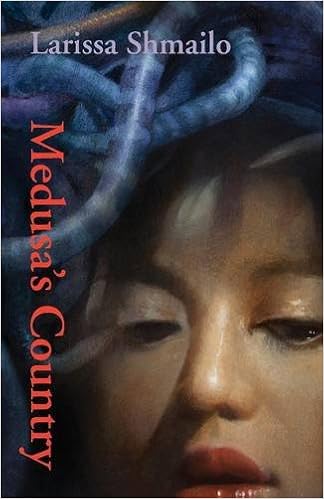
REVIEW OF MEDUSA'S COUNTRY

Michael T. Young's beautiful review of MEDUSA'S COUNTRY.


Aching toward Redemption: a review of Medusa’s Country by Larissa Shmailo


Reviewed by Michael T. Young
Medusa’s Country
by Larissa Shmailo
MadHat Press 
2016, 70 pages, $14.95, ISBN: 978-1941196380
It’s been said that there are only two subjects in literature: love and death; Medusa’s Country is the battle between those primal forces. It’s no wonder that battle, and the country where it takes place, are hard given the power the eponymous figure is known for. As the poem “Schweinerei” says of the world, it is “hard, atrocious, and cruel”[i]And what makes the country of this collection especially so is that it is not fantasy, like medusa herself; but rather a steady look at the reality of our own world: a world of war, rape, suicide, where “life is real; and death the realest part” (28).
But let’s delve more carefully, because such a description may give the false impression of depressing teenage verse, and the poetry of Medusa’s Country is far from that. It is rather the poetry of experience and not of innocence. It is a collection of incredibly intelligent and subtle poetry that never loses focus of its themes. It is a poetry that aches toward redemption even as it is bogged down by histories and impulses that cannot be undone. So between the transcendent and the incarnate there is a wrestling for justice.
After torture and rape a child dies, finally;
The suffering of innocents, God’s gaping sore.
Still I pray daily, but I’m mad, you see. (31)
The reach toward love, toward what transcends the pain and suffering of the world, results in an embodiment. That embodiment becomes a confinement, a trap, and thus a kind of failure. As Joseph Brodsky once said, “In poetry, as anywhere else, spiritual superiority is always disputed at the physical level”[ii]. Shmailo’s poems rage at the center of that dispute and thus the governing metaphors tend toward the claustrophobic and crippled.
Your empty heart can’t know love’s blood at all.
You’ll be my heart, a numb, reflexive pleasure
to beat, half-heart, and never know full flexure. (21)
Family history
is largely hysterical mystery.
This old cold sold blow hold on me
is moldy genealogy. (12)
In that “love’s blood,” in that “reflexive pleasure,” that “moldy genealogy,” is a determinism that belies all effort to a transcendent love. And this makes that desire so painfully felt. I’m reminded, at times, of the aridity and emptiness that St. John of the Cross explores in Dark Night of the Soul. Shmailo, in longing to transcend the pain of the world, embraces a totality that inverts ordinary terms:
I love love’s desert and its snow.
I, Shmailo, dervish, a lover signed. (51)
Or as in the first footnote to “Between Eclipses” says, “It is not the grace of salvation you await, but the grace of no salvation” (10).
At the end of the second section, the spiritual dispute surfaces as an aching for an end to the boundaries of the self. And this is where death and love seem to become almost indistinguishable. In the final section of a poem called “War,” we read
Maybe as the last breath—will we know it as last?—as the last
breath goes, we—will we know any we?—we might feel another’s
dying breath that we might know someone else’s as we know our own
death. (38)
In Eastern philosophy and on the subatomic level in science, the boundaries that separate us become tenuous. So, the final section, in the wake of this poem, enters realms of quantum physics and Hinduism.
I’m the field of every being;
parts of me are parts of you. (47)
This is me, it cries, this is me and I die.
We will all speak these words in this way
and then, and till then, what shall I say? (55)
The final section from which these poems come is the collection’s supreme effort toward redemption. But love must ever return to its embodiment and, therefore, a kind of entrapment. Transcendence is not permanent but only part of a cycle.
I will make love to you between rebirths
with penis and womb, with land and sea,
with wind and sun and death. (49)
Buried within that sentence loaded with polysyndeton is the phrase, “I will make love to you . . . with. . . death.” If an orgasm is “le petite mort” one gets the sense from this collection that death is a “grande orgasme,” and the cycle of rebirth returns us to the desires of a body that can’t shake its history or primordial urges. As the collection concludes with the poem that gives the collection its name:
The water will dry and will leave only dust;
I will feel no prick when it does.
The serpentine grass will cover my love
And green growth enshroud what was.
But once a man stood like a statue
Before my cave of trees
His eyes transfixed by my serpents
That hardened, froze, and pleased. (56)
Apart from that return to dust and resolving into bitter memory, it’s important to note the innuendo that plays through the lines, for Shmailo’s poetry is abundant with linguistic wit and wordplay. As here, “I will feel no prick as it does” simultaneously means “prick” as a penis and “prick” as a pang of grief or anguish. And that is equally part of the hardness learned by a hard life. It is forgiveness learned through pain, as in the poem “Rape,” where a footnote tells us:
“Through the ability to understand how little you cared, I grew strong. I forgave and forgot you, like used toilet paper, flushed” (29).
Sexual love and transcendent love become indistinguishable and so transcendence slips away and the harshness of the world crowds in. We are left with terrible longing. But also the beauty of the language, a beauty that has the power to transform the tragic into song.
One of my personal favorite poems in the collection is “Live, Not Die; Live Not, Die.” It’s a marvelous variation on that unwieldy form, the sestina. But more than this, it is a poem of both linguistic and ideational play that is dreadfully serious. Springing off of Hamletand his ponderous question of existence, it goes on to weave in relevant references to Eliot and Marvell, and, of course, questions of love. The poem exemplifies the intelligence that pervades the collection in double-entendres, in deep engagements with literary figures like Nabokov, Tolstoy, or Lermontov, or in pressing literary forms into a painful service as when a limerick is used to talk about a crematorium in a death camp.
It’s important to remember that medusa was once beautiful and was changed into a hideous creature by failing to keep her vows as a priestess of Athena. The pain and suffering traced through Medusa’s Countryare like a series of betrayals that results in a similar curse. The beauty that is written into the language, and painted into the cover art, are undeniable. But the world will not let beauty go untouched. It forces the hard choices, rendering them as compulsions of survival and so torturing the beautiful into the hideous.
In the movement of poems from formal to free verse and back, there is a push against restraints both in theme and form. So Shmailo’s “Cardiac Ghazal” is written in iambic hexameter rather than the more common pentameter and her villanelle “Apostasy” resists any definite meter when scanned and yet the muscular character of the words and rhythms works well with the outrage of confronting the injustice of children raped and driven to suicide.
If I find a disappointment anywhere in the book, it is only in the few moments of failed editing or formatting which falls on the publisher’s shoulders. So, there is a comma or period out of place on occasion and the opening comments by Steve Dalachinsky misquotes one of the poems in a significant way. But these are not, as I say, errors that are to be lain at the poet’s feet. No, in fact, if anything is to be lain at Shmailo’s feet it is the laurel of antiquity in recognition of her mastery as a poet.
[i]Larissa Shmailo, Medusa’s Country(Asheville: MadHat Press, 2017), 34.
[ii]Joseph Brodsky, Less Than One: Selected Essays(New York: Farrar Straus Giroux, 1986), 133.
About the Reviewer: Michael T. Young‘s third full-length collection, The Infinite Doctrine of Water, was published by Terrapin Books. His chapbook, Living in the Counterpoint (Finishing Line Press), received the 2014 Jean Pedrick Chapbook Award from the New England Poetry Club.  His other collections include The Beautiful Moment of Being Lost (Poets Wear Prada), Transcriptions of Daylight (Rattapallax Press), and Because the Wind Has Questions (Somers Rocks Press).  He received a fellowship from the New Jersey State Council on the Arts and the Chaffin Poetry Award.  His work has appeared or is forthcoming in numerous print and online journals including The Cimarron ReviewThe Cortland ReviewEdison Literary Review, Lunch Ticket, The Potomac Review, and Valparaiso Poetry Review.  His work is also in the anthologies Phoenix Rising, Chance of a Ghost, In the Black/In the Red, and Rabbit Ears: TV Poems.  He lives with his wife and children in Jersey City, New Jersey.

Sunday, April 22, 2018

Poems for Earth Day


Degree
Look up, the water is rising again; the ocher ocean
is warmer today. The sea mists rise, form grey clouds
named Harvey and Irma and Jose and they reign,

mad royalty, over earth. Hush: The brown waters
rush into tributaries, to rivers, to the troubled chopped 
sea, where carbons heat the surface of salt; one degree,

and it rises hotter, wetter, wilder, whipping waves
of wind, winding toward us, a Kitty, Leo, Marie; a child,
looking at the sea, will die today, Noah, alee.

Plate Histrionics
  
He throws a gold-lamé wedding-set saucer
at me, and spits, “There is no
 global warm-ing.”

Today, Irma evacuates Sarasota as b-
rother Harvey peers and jeers, Ozymandiu-
s-like, Houston and Florida, look upon me.

A-s th-ese li-nes are bro-ken, so the dream-
s of cities, and those hamlets and towns a-
way where we settled to breathe, hear our-
selves think.

Cat 5, there is no stronger. An
evil fidget spinner, Irma swirls out of a wet
hell, and I holler CLIMATE CHANGE.

It is the
imitation
Wedgewood gravy boat, h-
e throws that next, jjjjjjjust before she

A Sonnet Affected by Climate Change

The Earth is mud and shale gas, molten magma, metamorphic—
Oh Sis, Oh Bro—and igneous, blast changing in its last tic,
with a heady burst of ozone, all zones, a corpse that ends in water.
Without us, climate will survive, change fast, outlast—Oh Daughter:
The equatorial world endures, we fall, all bone, all copses sick. 

Paleoclimatology predicts our fate.
Put the conundrum on another generation’s plate?
No, it’s now: in Africa, desertification scorches,
torches farmland. (HUNGER!!!!)
And the people learn of a Great Satan, a nation
that throws away food. Do you see
that they will fight because they must?
Whom will they trust? What is terror after you’ve
watched your child die in the land’s rust?

Blog Archive