Showing posts with label Medusa's Country. Show all posts

Friday, September 07, 2018

REVIEW OF MEDUSA'S COUNTRY

Michael T. Young's beautiful review of MEDUSA'S COUNTRY.


Aching toward Redemption: a review of Medusa’s Country by Larissa Shmailo
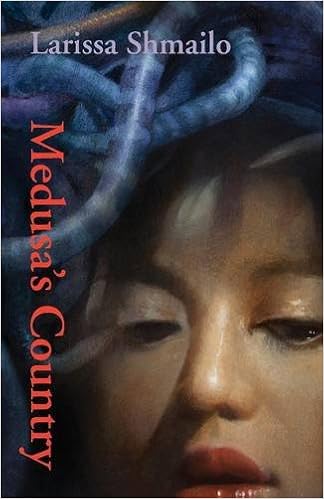

Reviewed by Michael T. Young
Medusa’s Country
by Larissa Shmailo
MadHat Press 
2016, 70 pages, $14.95, ISBN: 978-1941196380
It’s been said that there are only two subjects in literature: love and death; Medusa’s Country is the battle between those primal forces. It’s no wonder that battle, and the country where it takes place, are hard given the power the eponymous figure is known for. As the poem “Schweinerei” says of the world, it is “hard, atrocious, and cruel”[i]And what makes the country of this collection especially so is that it is not fantasy, like medusa herself; but rather a steady look at the reality of our own world: a world of war, rape, suicide, where “life is real; and death the realest part” (28).
But let’s delve more carefully, because such a description may give the false impression of depressing teenage verse, and the poetry of Medusa’s Country is far from that. It is rather the poetry of experience and not of innocence. It is a collection of incredibly intelligent and subtle poetry that never loses focus of its themes. It is a poetry that aches toward redemption even as it is bogged down by histories and impulses that cannot be undone. So between the transcendent and the incarnate there is a wrestling for justice.
After torture and rape a child dies, finally;
The suffering of innocents, God’s gaping sore.
Still I pray daily, but I’m mad, you see. (31)
The reach toward love, toward what transcends the pain and suffering of the world, results in an embodiment. That embodiment becomes a confinement, a trap, and thus a kind of failure. As Joseph Brodsky once said, “In poetry, as anywhere else, spiritual superiority is always disputed at the physical level”[ii]. Shmailo’s poems rage at the center of that dispute and thus the governing metaphors tend toward the claustrophobic and crippled.
Your empty heart can’t know love’s blood at all.
You’ll be my heart, a numb, reflexive pleasure
to beat, half-heart, and never know full flexure. (21)
Family history
is largely hysterical mystery.
This old cold sold blow hold on me
is moldy genealogy. (12)
In that “love’s blood,” in that “reflexive pleasure,” that “moldy genealogy,” is a determinism that belies all effort to a transcendent love. And this makes that desire so painfully felt. I’m reminded, at times, of the aridity and emptiness that St. John of the Cross explores in Dark Night of the Soul. Shmailo, in longing to transcend the pain of the world, embraces a totality that inverts ordinary terms:
I love love’s desert and its snow.
I, Shmailo, dervish, a lover signed. (51)
Or as in the first footnote to “Between Eclipses” says, “It is not the grace of salvation you await, but the grace of no salvation” (10).
At the end of the second section, the spiritual dispute surfaces as an aching for an end to the boundaries of the self. And this is where death and love seem to become almost indistinguishable. In the final section of a poem called “War,” we read
Maybe as the last breath—will we know it as last?—as the last
breath goes, we—will we know any we?—we might feel another’s
dying breath that we might know someone else’s as we know our own
death. (38)
In Eastern philosophy and on the subatomic level in science, the boundaries that separate us become tenuous. So, the final section, in the wake of this poem, enters realms of quantum physics and Hinduism.
I’m the field of every being;
parts of me are parts of you. (47)
This is me, it cries, this is me and I die.
We will all speak these words in this way
and then, and till then, what shall I say? (55)
The final section from which these poems come is the collection’s supreme effort toward redemption. But love must ever return to its embodiment and, therefore, a kind of entrapment. Transcendence is not permanent but only part of a cycle.
I will make love to you between rebirths
with penis and womb, with land and sea,
with wind and sun and death. (49)
Buried within that sentence loaded with polysyndeton is the phrase, “I will make love to you . . . with. . . death.” If an orgasm is “le petite mort” one gets the sense from this collection that death is a “grande orgasme,” and the cycle of rebirth returns us to the desires of a body that can’t shake its history or primordial urges. As the collection concludes with the poem that gives the collection its name:
The water will dry and will leave only dust;
I will feel no prick when it does.
The serpentine grass will cover my love
And green growth enshroud what was.
But once a man stood like a statue
Before my cave of trees
His eyes transfixed by my serpents
That hardened, froze, and pleased. (56)
Apart from that return to dust and resolving into bitter memory, it’s important to note the innuendo that plays through the lines, for Shmailo’s poetry is abundant with linguistic wit and wordplay. As here, “I will feel no prick as it does” simultaneously means “prick” as a penis and “prick” as a pang of grief or anguish. And that is equally part of the hardness learned by a hard life. It is forgiveness learned through pain, as in the poem “Rape,” where a footnote tells us:
“Through the ability to understand how little you cared, I grew strong. I forgave and forgot you, like used toilet paper, flushed” (29).
Sexual love and transcendent love become indistinguishable and so transcendence slips away and the harshness of the world crowds in. We are left with terrible longing. But also the beauty of the language, a beauty that has the power to transform the tragic into song.
One of my personal favorite poems in the collection is “Live, Not Die; Live Not, Die.” It’s a marvelous variation on that unwieldy form, the sestina. But more than this, it is a poem of both linguistic and ideational play that is dreadfully serious. Springing off of Hamletand his ponderous question of existence, it goes on to weave in relevant references to Eliot and Marvell, and, of course, questions of love. The poem exemplifies the intelligence that pervades the collection in double-entendres, in deep engagements with literary figures like Nabokov, Tolstoy, or Lermontov, or in pressing literary forms into a painful service as when a limerick is used to talk about a crematorium in a death camp.
It’s important to remember that medusa was once beautiful and was changed into a hideous creature by failing to keep her vows as a priestess of Athena. The pain and suffering traced through Medusa’s Countryare like a series of betrayals that results in a similar curse. The beauty that is written into the language, and painted into the cover art, are undeniable. But the world will not let beauty go untouched. It forces the hard choices, rendering them as compulsions of survival and so torturing the beautiful into the hideous.
In the movement of poems from formal to free verse and back, there is a push against restraints both in theme and form. So Shmailo’s “Cardiac Ghazal” is written in iambic hexameter rather than the more common pentameter and her villanelle “Apostasy” resists any definite meter when scanned and yet the muscular character of the words and rhythms works well with the outrage of confronting the injustice of children raped and driven to suicide.
If I find a disappointment anywhere in the book, it is only in the few moments of failed editing or formatting which falls on the publisher’s shoulders. So, there is a comma or period out of place on occasion and the opening comments by Steve Dalachinsky misquotes one of the poems in a significant way. But these are not, as I say, errors that are to be lain at the poet’s feet. No, in fact, if anything is to be lain at Shmailo’s feet it is the laurel of antiquity in recognition of her mastery as a poet.
[i]Larissa Shmailo, Medusa’s Country(Asheville: MadHat Press, 2017), 34.
[ii]Joseph Brodsky, Less Than One: Selected Essays(New York: Farrar Straus Giroux, 1986), 133.
About the Reviewer: Michael T. Young‘s third full-length collection, The Infinite Doctrine of Water, was published by Terrapin Books. His chapbook, Living in the Counterpoint (Finishing Line Press), received the 2014 Jean Pedrick Chapbook Award from the New England Poetry Club.  His other collections include The Beautiful Moment of Being Lost (Poets Wear Prada), Transcriptions of Daylight (Rattapallax Press), and Because the Wind Has Questions (Somers Rocks Press).  He received a fellowship from the New Jersey State Council on the Arts and the Chaffin Poetry Award.  His work has appeared or is forthcoming in numerous print and online journals including The Cimarron Review, The Cortland Review, Edison Literary Review, Lunch Ticket, The Potomac Review, and Valparaiso Poetry Review.  His work is also in the anthologies Phoenix Rising, Chance of a Ghost, In the Black/In the Red, and Rabbit Ears: TV Poems.  He lives with his wife and children in Jersey City, New Jersey.

Thursday, August 02, 2018

LAST DAY TO ENTER MEDUSA'S COUNTRY GIVEAWAY!

Today is the last day to enter the Goodreads book giveaway to win a free copy of MEDUSA'S COUNTRY, poetry with a kick! Final hours - enter today!


ENTER THE GOODREADS GIVEAWAY HERE!

Tuesday, July 31, 2018

Book giveaway - 3 days left

Win a free copy of MEDUSA'S COUNTRY, "a new book of searingly intelligent poems from a uniquely eloquent poet." Three days left!

ENTER THE MEDUSA'S COUNTRY GIVEAWAY HERE!


Sunday, July 22, 2018

Goodreads Giveaway - Win a Copy of MEDUSA'S COUNTRY

This week only, enter the Goodreads Giveaway to win a free copy of MEDUSA'S COUNTRY, a poetry collection that says #metoo with a kick!  Time and number of copies are limited, so enter today!

ENTER THE MEDUSA'S COUNTRY GIVEAWAY HERE!


Friday, October 13, 2017

Review of MEDUSA'S COUNTRY by Meredith Sue Willis in Books for Readers

Medusa's Country is more stunning poems from Larissa Shmailo. She is endlessly surprising, riffing off other literature-- an erasure poem using lines from "The Lotus Eaters" section in Joyce's Ulysses; one called "My Vronsky" with reference to Nabokov's failure to understand Anna Karenina-- but also about a relationship destructive to the narrator. There is also a poem called "Daddy's Elusive Love" with short lines and hard-hitting rhymes like 's Sylvia Plath's famous "Daddy." Shmailo's Daddy,. though seems to have hidden his love.

I looked for it in boxers;
In the dumps of ten detoxes;
In the roll of rundown rockers;
In anal & banal boys.

There is, of course, a lot more Here, as in her previous books, we have passages of her personal story of living on the edge and in the lower depths as in the "The Trick Wants to Go to Plato's," the old Plato's Retreat sex club where single men aren't. The narrator, who is indeed in the sex business, says " I sign a document attesting that I am not a prostitute; my whore name is Nora."
These poems alternate with ones using myth and rhyming patterns and parody (See "Fragment from the Ilatease of Homey, from a Recently Discovered Mycenaean Test." The final poem of the book, the title poem, about Medusa, ends

But once a man stood like a statue
Before my cave of trees
His eyes transfixed by my serpents
That hardened, froze, and pleased.

You will never be bored by Larissa Shmailo's poetry. I don't suppose that sounds like much of a recommendation to read it, but what I want to say is that her inventiveness and wit are only matched by her searing life experiences and her observation of death.
She surprises over and over.

Wednesday, June 28, 2017

Review in The Lit Pub of Medusa's Country

Medusa's Country by Larissa Shmailo

06/27/17
Medusa peels herself from the pages of mythology to become a denizen of New York City’s margins. There, she waltzes with Thanatos: “The dance with death? / Ah, this: as I flirt, you draw near.” When Eros shows up, he lures Medusa on a peregrination toward a broken self: “My naked heart unrobes, undressed of anguished cries.”
Shmailo adds, “Larissa’s rose is sick and is consuming me.” This alludes to William Blake’s poem “The Sick Rose,” pertaining to self-destructive sexuality. While beautiful, the rose has become infected by a worm. Addressing herself in an epistolary moment, Shmailo states, “Dear Friend of ferment / who unearths worms // that enrich this blissful human soil.”
Here lies one of many moments of transformation. The poet, though brutally honest about her bouts with mental illness, mania, and deleterious behaviors, also acknowledges the alchemy available by casting pain into language. Purged, the expectation for starting anew enriches this “human soil,” fecund with possibility and, surprisingly, hope. Here is one of the many strengths of this collection of poems—it is relentlessly honest and (therefore) resilient.
These qualities guide the poet’s exploration. Along the way, the gorgon assumes other personae, including a prostitute named Nora, a reluctant villain, not unlike Medusa herself. Once, one of Athena’s priestesses, she was raped by Poseidon. Instead of being seen as the victim, Medusa was held responsible by Athena, who turned the gorgon’s curls into snakes (Blake’s worm?) and made all who gazed upon her turn to stone. Medusa was ostracized by her own power. Shmailo avers, “His eyes transfixed by my serpents / that hardened, froze, and pleased.” Indeed, misogyny has—from antiquity to Ibsen’s era to the present—castigated women who dared to exhibit intelligence and power. Many of these poems lead the reader through histories of misogyny and sexual abuse (as in the myth itself). In a poem titled “Rapes,” Shmailo confesses:
I abandoned myself to invisible hands,
the known vice and the strong vise of my nerves and my glands.
I half-screwed and cat-moaned and imagined your stare
in the stranger, his knife slowly teasing my hair.
She unpacks her poet’s suitcase of prosody and nuanced rhymes, knowing that a poem is not only about a given topic, but also about the agency of language itself. Like a stab, she writes, “The rapist called me fat.” Again, the victim, not the perpetrator, is rebuked. Nonetheless, these poems ultimately serve a triumphant voice—a brave and audacious “I.” Convinced of her prowess, this Medusa stares into her own mirror, where she confronts distorted notions of normalcy: “You, my reflection, in pain,” and, “We live in parts.”
Despite landing on a psychiatric ward, she frees herself with sardonic wit and blade-sharp language: “Bellevue, Bellevue, where nurses’ crazy laughter / rings through the night.” The writing is so visceral, the reader feels trapped in the “locked ward,” along with the author. One can hear the howls and smell the disinfectants.
However, with verve, with chutzpah, with urgency, Shmailo’s poems become spells, freeing her, transforming stone into flesh:
I spent my whole life seeking it,
wrecking, reeking, eking it,
in hydra-headed phalluses;
in aliases & pal-louses;
in papapapapaMedusas;
in mirrors & seducers.
Ultimately, she magicks death into an affirmation of life: “I love love’s desert and its snow.” Indeed, she has led us from one extreme terrain to another—and back to the silence of the page, where we marvel at her hard-won wholeness. As we read this book, it becomes our own.


Wednesday, May 03, 2017

Book Launch Party for Medusa's Country

Come celebrate the launch of my new book of poetry, Medusa's Country - and wish me a happy birthday! Readings by Marc Vincenz, Lee Ann Brown, Tim Fitts, Ron Kolm,and Irina Mashinski. Hosted by Dean Kostos. Refreshments will be served.
Tuesday, May 30, 6:00 pm
Cornelia Street Cafe
29 Cornelia Street  
New York, NY
$10 includes bar drink.


Monday, April 03, 2017

Interview about Medusa's Country

Interview about my new book of poetry, Medusa's Country

Monday, April 3, 2017


Interview with author Larissa Shmailo in BookMarketing Buzz 

       
Medusa’s Country


1. What really inspired you to write your book, to force you from taking an idea or experience and conveying it into a book? I write for two reasons: to sort out my life and to experiment with language. In the case of Medusa, I was experimenting with something new to me, formal poetry (I had mostly been an experimentalist and spoken word poet before).So what would prostitution, addiction, misogyny and obsessive love look like in form? Medusa’s  Country is the answer.
           
2. What is it about and whom do you believe is your targeted reader? Like all my work, it is about traumata, the female kind, and also about pushing the envelope of poetic style. I think women will identify and men will learn something.         
           
3. What do you hope will be the everlasting thought for readers who finish your book? What should remain with them long after putting it down? The main thought, I hope, will be about the power of literature to help people transcend horrors, to grow beyond trauma to victory and inner peace.
           
4. What advice or words of wisdom do you have for fellow  writers? Keep writing. Certainly keep your eye out for what is good in other people’s work, but always trust your own voice, your own inspiration, your own truth first.
                       
5. What trends in the book world do you see and where do you think the book publishing industry is heading? A blurring of the line between big mainstream publishers and small press, as some of the latter get bigger, use big distribution outlets, find their way into big media coverage, grow audiences as my publisher has.
           
6. What great challenges did you have in writing your book? None. Those all came before I became a writer. It’s been pretty smooth sailing ever since.     
           
7. If people can only buy one book this month, why should it be yours? People who say they don’t like poetry inevitably say about mine, “Hey, this is good.” And the book tells a story of redemption from despair and degradation to a beautiful life of love and creativity. I think the book entertains and inspires.

Larissa’s work appears in Measure for Measure (Everyman's Library / Penguin Random House), Words for the Wedding (Perigee / Penguin Putnam), Contemporary Russian Poetry (Dalkey Archive Press), Resist Much / Obey Little (Spuyten Duyvil Press), and over thirty other anthologies. Larissa's poetry collections are Medusa’s Country (MadHat Press). #specialcharacters (Unlikely Books), In Paran (BlazeVOX [books]), and the chapbook A Cure for Suicide (Červená Barva Press), and e-book Fib Sequence (Argotist Ebooks). Her poetry CDs are The No-Net World and Exorcism (SongCrew); tracks are available from Spotify, iTunes, Muze, and Amazon. Larissa translated Victory over the Sun for the Los Angeles County Museum of Art's celebrated reconstruction of the first Futurist opera; the libretto has been used for productions at Brooklyn Academy of Music, the Smithsonian, and the Garage Museum of Moscow. Larissa edited the anthology Twenty-first Century Russian Poetry (Big Bridge Press) and has also been a translator on the Russian Bible for the American Bible Society. Her novel, Patient Women, is now available from Amazon, BN.com 

http://bookmarketingbuzzblog.blogspot.com/2017/04/interview-with-author-larissa-shmailo.html

Wednesday, March 29, 2017

FOR IMMEDIATE RELEASE: A WOMAN’S RAGE, LOVE, IDENTITY: MEDUSA’S COUNTRY

FOR IMMEDIATE RELEASE:A WOMAN’S RAGE, LOVE, IDENTITY: MEDUSA’S COUNTRY

Contact:    Marc Vincenz 
               Marc.l.vincenz@gmail.com (617) 821-1915              
or
               Larissa Shmailo
               larissa@larissashmailo.com, (212) 712-9865

Poet, novelist, translator, editor, and critic Larissa Shmailo presents her third book of poetry, Medusa’s Country. Channeling the powerful female monster Medusa, she sings about addiction, toxic relationships, real love, and the path to finding one’s identity: From “To the Thanatos within Me”:
What catharsis there is in the dive,
the gesture, the infinite jest,
the slash, the brush (its own fire),
the dance with death?
Larissa Shmailo’s translations from Russian include the iconic avant-garde opera Victory over the Sun; her latest novel is Patient Women. For more information please see Ms. Shmailo’s Wikipedia page at https://en.wikipedia.org/wiki/Larissa_Shmailo and her website at www.LarissaShmailo.com, including the Electronic Press Kit (with high-resolution photos) at www.larissashmailo.com/sites/default/files/larissa_shmailo_electronic_press_kit.pdf. Ms. Shmailo is available for booking at (212) 712-9865. Medusa’s Country is available for purchase through Amazon, www.madhat-press.com, and at major distributors and bookstores. Review copies are available upon request.

Praise for Medusa’s Country
“Gut-wrenching honesty, spiritual courage, and unflinching vision are what it takes to visit Medusa’s Country. [Larissa draws] on the experience of her immense challenges—prostitution, alcoholism, drugs and insanity—and her immense advantages—a gift for poetic form, a razor-sharp mind, the spirit of a mystic, and a deep intimacy with world literature and culture— to share with us precious and hard-learned lessons: the necessity not only to survive but to triumph, and the crucial place of art and culture in that achievement.”
—Annie Finch, author of A Poet’s Craft: A Comprehensive Guide to Making and Sharing Your Poetry
“Medusa peels herself from the pages of mythology to become a denizen of New York City’s margins. . . Along the way, the gorgon assumes other personae, including a whore named Nora. These poems lead the reader through histories of misogyny and sexual abuse. Convinced of her prowess, this Medusa stares into the mirror, where she confronts distorted notions of normalcy. Despite landing on a psychiatric ward, she frees herself with sardonic wit and blade-sharp language. With verve, with chutzpah, with urgency, Larissa Shmailo’s poems are spells, transforming stone into flesh and death into an affirmation of life.”
—Dean Kostos, author of This Is Not a Skyscraper
# # #

Saturday, March 25, 2017

Blurbs for Medusa's Country

PRAISE FOR MEDUSA'S COUNTRY
What a gift: a new book of searingly intelligent poems from a uniquely eloquent poet. Gut-wrenching honesty, spiritual courage, and unflinching vision are what it takes to visit Medusa’s Country. It’s not easy to find a guide to take you there, but Larissa Shmailo is ready for the job. She spares herself—and her reader—no pains in the search for home, drawing on the experience of her immense challenges—prostitution, alcoholism, drugs and insanity—and her immense advantages—a gift for poetic form, a razor-sharp mind, the spirit of a mystic, and a deep intimacy with world literature and culture— to share with us precious and hard-learned lessons: the necessity not only to survive but to triumph, and the crucial place of art and culture in that achievement. Brace yourself. Medusa’s Country is a book to savor, and Larissa Shmailo, novelist, translator, and poet of urgent maturity and resonant depth, is a writer to watch.
—Annie Finch, author of A Poet’s Craft: A Comprehensive Guide to Making and Sharing Your Poetry

Reading Larissa Shmailo's hypnotic Medusa's Country feels to me like cracking open a rare blue lobster to find a cache of rich, luscious green stuff contained within a living thing. At the heart of this viscerally dictioned masterwork of myth and ritual is an uncompromising dedication to formal poetic innovation. These poems parse matters of sex and literature, of life and death, not only of "I, Shmailo, dervish, a lover signed," but of all who walk the questioning edges of sound, sense and what poetry can do to you. 
—Lee Ann Brown, author of Other Archer and In the Laurels, Caught 
Medusa peels herself from the pages of mythology to become a denizen of New York City’s margins. There, she waltzes with Thanatos: “The dance with death? / Ah, this: as I flirt, you draw near.” When Eros shows up, he lures Medusa on a peregrination toward self. She packs her poet’s suitcase of prosody and nuanced rhymes. Along the way, the gorgon assumes other personae, including a whore named Nora. These poems lead the reader through histories of misogyny and sexual abuse. Convinced of her prowess, this Medusa stares into the mirror, where she confronts distorted notions of normalcy. Despite landing on a psychiatric ward, she frees herself with sardonic wit and blade-sharp language. With verve, with chutzpah, with urgency, Larissa Shmailo’s poems are spells, transforming stone into flesh and death into an affirmation of life.
—Dean Kostos, author of This Is Not a Skyscraper

Medusa’s Country lies somewhere between the medulla oblongata & the soul. piercing the body as you enter into it. lying in wait for the reader are many headed poems, some venomous, others painfully sweet, yet filled with melancholy & longing. some are songs about songs. arrhythmic rhymes that seduce the psyche. brutally honest & at times, frightening. rarely serene. all based in the mythology of what we refer to as “reality.” engaged with & trapped within their own freedoms. greco-roman images lying naked beside woody allen’s bad jokes, engulfing the elements, earth, stone, air, water with their “suicidal impulses,” varied forms & dreams. what is revealed is a mind tortured by its own beauty, anger & distress. a heart filled with emotions, denials, betrayals & refusals. self-denial & self-assurance. pride. pimps. hookers. lonely homeless “aliens.” 
this is a dance with death, love & an abundant ability to caress language & all its nuances. “the dead are dead, but not within me, my holocaust today, forever my bread.” a new archaic modernism much needed in a world of false romanticism & post-post language-oriented verse where the beauty of word/image has all but been subverted, seduced, abandoned & forgotten. even as shmailo decries “larissa’s rose is sick & consuming me” what we feel, beside extreme empathy, is the strength of her life force/breath as it forges onward while pondering even plundering itself. there are love poems that “crack…the force of gravity.” pleas. accusations. threats. drug induced psychoses. confessions of an often poisoned “being” who is so aware of the poison in others. “your heart beats not for me…your empty heart…you’ll be my heart / a numb flexible pleasure.” reach out & allow these poems touch you with their passions as they “turn particles into power.”
—steve dalachinsky nyc sept. 2016

There are days I am bored with poetry and days I think it is a waste of human effort. Reading Larissa Shmailo’s collection reminds me why I love the genre and proves what kinds of beauty and intelligence can exist in language. There is a lyric lift to every line and a direct honesty in every message that heartens me and renews me. The poems in this book deserve to be read and read again. I thank the poet for the renewal of faith.
—Okla Elliott, author of The Cartographer’s Ink and From the Crooked Timber

Thursday, November 17, 2016

Front and Back Cover of Medusa's Country with Blurbs

Here is the full cover, front and back, of my newest poetry collection, Medusa's Country, with blurbs from the brilliant Annie Finch, Dean Kostos, and Lee Ann Brown. The title launches next year at AWP Washington (yep, Washington). Thanks to MadHat Press and its genius publisher and cover artist for Medusa, Marc Vincenz!

Wednesday, August 31, 2016

Cover of my new collection, Medusa's Country

So excited to share the cover of my new poetry collection, Medusa's Country! Cover art is by Robert Hunt and cover design is by Marc Vincenz. The book, from MadHat Press, launches at AWP17!

Thursday, August 04, 2016

Madhat Press to publish my poetry collection, Medusa's Country

I'm thrilled to announce that Madhat Press will publish my third full-length poetry collection, Medusa's County. Thanks to Marc Vincenz and Mad Hatters everywhere!

Blog Archive